Ortofon 2M Black Moving Magnet Phono Cartridge Review (2026)
Updated September 14, 2026 · Research-based review
Our verdict
The Ortofon 2M Black is the flagship of Ortofon's 2M moving magnet line, built around a nude Shibata stylus for detail and low distortion that the entry 2M models do not match. It rewards a precisely set up, high-quality turntable and phono stage, and its price only makes sense on gear good enough to show off what it can do.
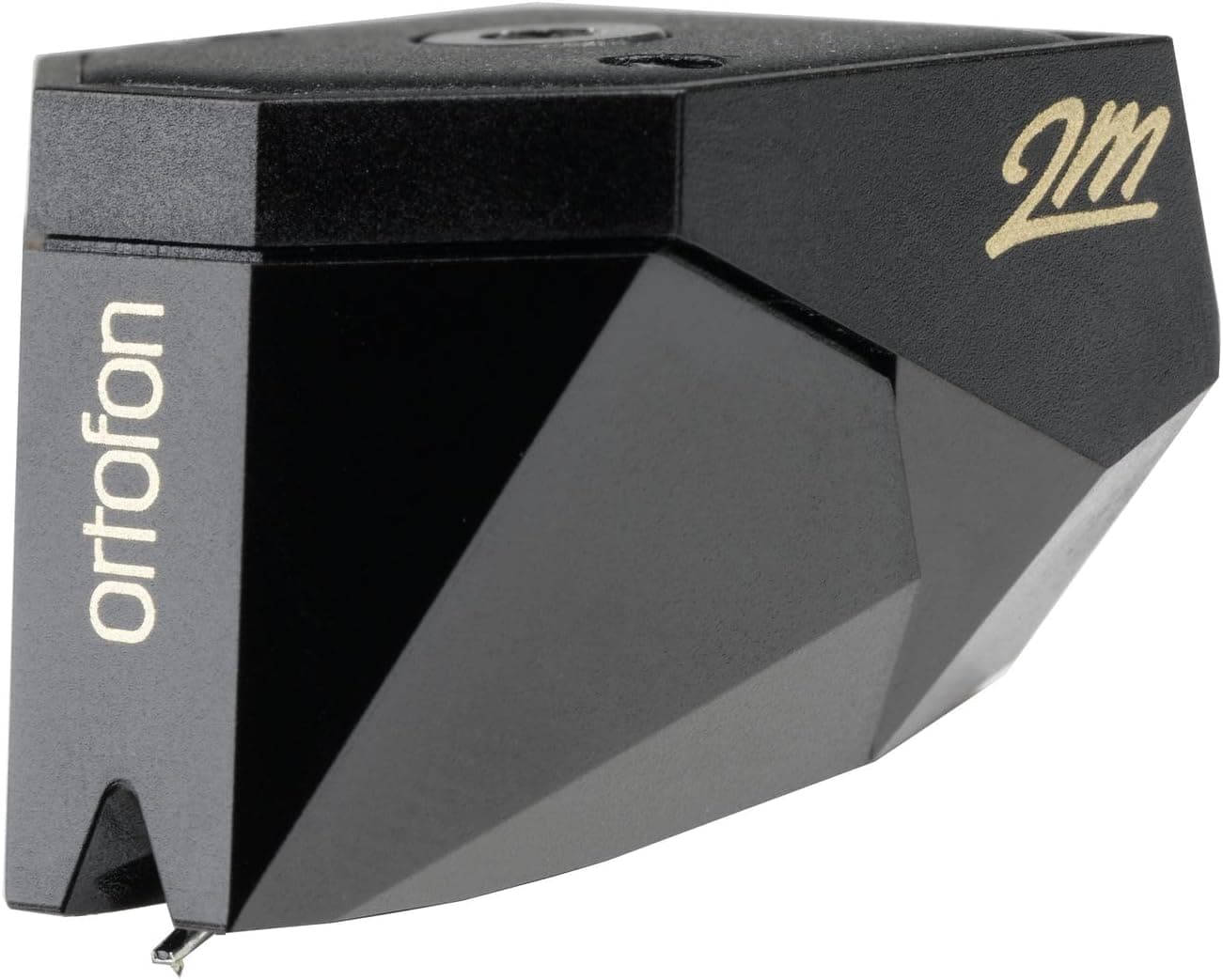
Ortofon 2M Black moving magnet cartridge with a Shibata stylus, Ortofon's flagship 2M model for serious MM listeners.
Price range: See on Amazon
What we liked
- + Shibata stylus delivers top-tier detail and very low distortion
- + Flagship 2M build suits high-quality tonearms and phono stages
- + MM output works with standard phono inputs, no step-up needed
Trade-offs
- - Expensive cartridge that deserves a turntable to match
- - Shibata profile demands precise alignment and azimuth setup
Who this cartridge is for
The 2M Black sits at the top of Ortofon's 2M range, above the Red, Blue and Bronze models, aimed at listeners with a turntable and phono stage capable of resolving what a genuinely high-performance moving magnet cartridge can deliver. Ortofon fits it with a nude Shibata diamond stylus rather than a bonded tip, a construction that costs more to produce but tracks the groove wall with more precision and less distortion. Because it uses a standard moving magnet output, it works with any conventional phono input without needing a step-up transformer or a specialized MM-only phono stage, keeping system matching simple even though the cartridge itself is a serious upgrade over entry-level models.
Specs and design in plain English
Ortofon specifies the 2M Black with a nude Shibata stylus at a 6 by 50 micron tip radius, an output voltage of 5 mV at 1 kHz, and channel separation greater than 27 dB at 1 kHz, notably higher than the entry 2M Red or Blue models. The cantilever is boron rather than the aluminum used further down the range, contributing to lower moving mass and better high-frequency tracking. Recommended tracking force sits at 1.6 grams within a 1.5 to 1.7 gram range, tighter than many cartridges, which means the tonearm's counterweight needs to be set accurately. Ortofon also states the stylus can deliver up to 1,000 hours of use without a meaningful drop in performance when handled and stored properly.
Setting it up and caring for it
Because the Shibata stylus profile is more sensitive to misalignment than a spherical or elliptical tip, mounting the 2M Black correctly means using a proper alignment protractor to set overhang and azimuth, not just eyeballing the cartridge into a headshell. Tracking force should be set precisely to the recommended 1.6 grams rather than rounded to the nearest half gram, since the narrow 1.5 to 1.7 gram window is part of how the stylus achieves its low distortion figures. Day to day, keeping the stylus tip clean with a soft brush before each side matters more with a Shibata profile than with a simpler stylus shape, since the fine-line contact area collects debris more readily. Store the cartridge's protective stylus guard in place whenever the turntable is not in use.
Trade-offs and how it compares
Against the Audio-Technica AT-VM95ML, which also uses a fine-line style stylus at a lower price, the 2M Black costs more but adds Ortofon's boron cantilever and tighter tolerances, a difference that matters most on higher-resolving systems. Within Ortofon's own range, the 2M Red and 2M Blue cost less and use simpler stylus profiles, making sense for turntables that will not reveal the 2M Black's extra resolution anyway. The AT-VM95E, a budget elliptical cartridge, is not a real rival in performance terms, more a starting point that some listeners eventually move on from toward something like the 2M Black once their system and ears are ready for it.
Verdict and who should pick something else
The 2M Black earns our score of 9.2 out of 10 as a genuinely high-performing moving magnet cartridge for listeners with a turntable, tonearm and phono stage that can show off what a Shibata stylus and boron cantilever bring to the table. It suits an audiophile-leaning system where the owner is willing to align it precisely and treat it with care. Listeners on a modest turntable, or those unwilling to use a proper alignment protractor, will not hear the full benefit and should consider the 2M Red or Blue instead. Anyone assembling a first serious hi-fi setup should budget for a comparable phono stage and tonearm alongside the cartridge, since the 2M Black is built to be the strong link in a chain, not to compensate for weak ones.
Frequently asked questions
What stylus does the Ortofon 2M Black use?
It uses a nude Shibata diamond stylus with a 6 by 50 micron tip radius, a finer profile than the bonded styli on the entry 2M Red and Blue models.
What tracking force does the 2M Black need?
Ortofon recommends 1.6 grams, within a narrow 1.5 to 1.7 gram range, so the counterweight needs to be set accurately for best performance.
Does the 2M Black need a special phono stage?
No, it is a standard moving magnet cartridge that works with any conventional MM phono input, without needing a step-up transformer.
Is the 2M Black worth it over the cheaper 2M Red?
It offers a finer Shibata stylus and boron cantilever for more detail and lower distortion, but that benefit is most audible on a higher-quality turntable and phono stage.
Prices change often, so check the current price and availability on Amazon.
Check price on AmazonTurntable Nest may earn a commission from the link above.