Fluance RT81 Turntable with AT95E Cartridge, Belt Drive, Built-in Preamp - Piano Black Review (2026)
Updated September 14, 2026 · Research-based review
Our verdict
The Fluance RT81 in piano black suits someone building a first real hi-fi setup who wants an elliptical cartridge and a switchable preamp instead of a plastic all-in-one deck. The aluminum platter and S-type tonearm punch above the price, but the manual arm and glossy finish need more day to day attention than an automatic, matte deck.
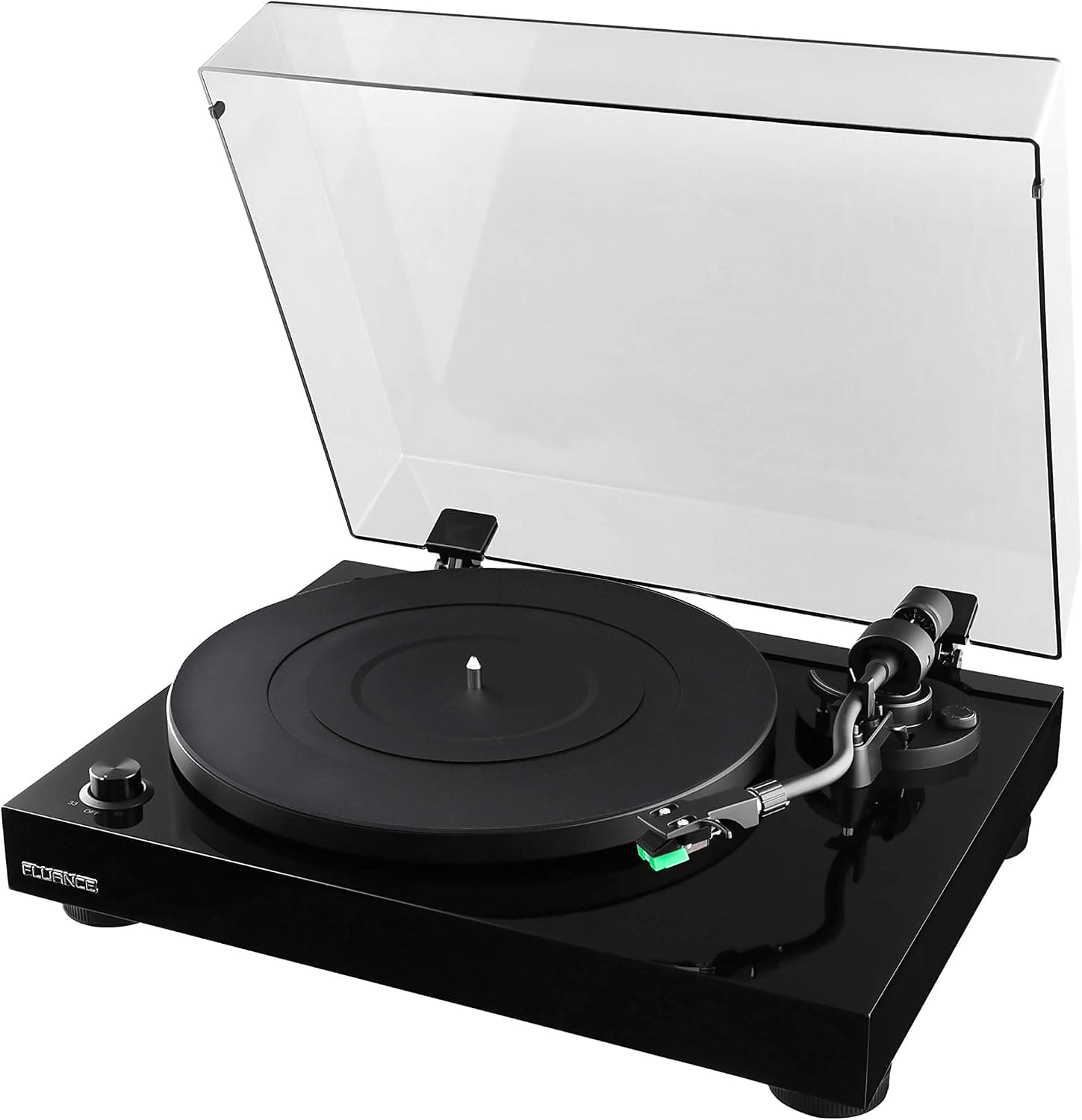
Fluance RT81 in piano black with an AT95E cartridge, a belt-drive budget deck with preamp for a first proper hi-fi setup.
Price range: See on Amazon
What we liked
- + AT95E elliptical cartridge brings more detail than conical budget styli
- + Built-in preamp can be bypassed later when you add a dedicated phono stage
- + Piano black finish fits easily into most media units and shelves
Trade-offs
- - Manual arm return means you must be around when each side finishes
- - Glossy finish shows fingerprints and dust more than matte plinths
Who the piano black RT81 is built for
The RT81 targets a buyer stepping up from a Bluetooth all-in-one player to a component turntable meant to connect into a real stereo, whether that means an existing receiver, a pair of powered speakers, or a future dedicated phono stage. The piano black gloss finish suits a media unit or shelf where a mirror-like cabinet fits the room, as opposed to the walnut veneer version aimed at a warmer, more traditional look. Because the tonearm is manual and there is no auto-stop, it is a better match for someone willing to be in the room when a side ends rather than someone wanting a fully hands-off, walk-away experience, and the glossy surface will need more regular dusting than a matte plinth in a household with pets or a lot of foot traffic nearby.
Tonearm, cartridge and preamp explained
Fluance builds the RT81 around a static balanced S-type aluminum tonearm with an adjustable counterweight and anti-skating control, paired with Audio-Technica's AT95E cartridge, which uses a bonded elliptical diamond stylus on an aluminum cantilever tracking at about 2 grams, a clear step above the conical styli found on budget decks. The platter is aluminum rather than plastic, which helps dampen vibration, and it sits on a DC motor belt-drive system rated for tight speed accuracy at both 33 and a third and 45 RPM. A built-in Texas Instruments preamp can be switched in for a direct connection to powered speakers or a receiver without a phono input, or switched out once the owner adds a dedicated external phono stage, giving the deck room to grow with a stereo system.
Setup, daily use and maintenance
Getting the RT81 running means placing the platter and mat, threading the belt around the sub-platter and motor pulley, mounting the counterweight to match the tracking force in the manual, and setting the anti-skating dial before the first play, a task most owners handle once with the included instructions. Day to day, records are cued and lifted by hand, and the tinted, hinged dust cover keeps dust off the platter between sessions, which matters more on a gloss finish that shows fingerprints and dust readily. Long-term care is standard for a belt-drive turntable, meaning an occasional stylus brush, keeping the unit away from direct sunlight and heat that can stretch the belt, and checking that the belt itself has not slipped or stretched after a few years of regular use.
Trade-offs and how it compares with other budget decks
Against its own walnut sibling, the Fluance RT81 Elite, the piano black version uses the same core electronics and AT95E cartridge, so the choice mostly comes down to finish preference and how much fingerprint upkeep an owner wants to deal with. Against the Audio-Technica AT-LP60XBT, the RT81 gives up fully automatic operation and Bluetooth streaming in exchange for a better cartridge and a detachable headshell that supports future upgrades, a fair trade for anyone focused on sound over convenience. Against the Denon DP-300F, another fully automatic deck, the RT81 again asks for manual cueing but answers with the higher-grade AT95E stylus, so the pick depends on whether hands-off operation or cartridge quality matters more to the buyer.
Verdict for first-system shoppers
Our score of 8.6 out of 10 reflects a turntable that delivers real hi-fi components, an elliptical cartridge, an aluminum platter, and a switchable preamp, at a price usually reserved for far simpler decks, making it one of the stronger entry points into component-based vinyl listening. It is the right pick for anyone ready to connect a turntable into an actual stereo system and willing to handle a manual arm and a glossy cabinet that shows dust. Buyers wanting Bluetooth streaming, fully automatic play, or built-in speakers should look at an all-in-one or automatic model instead, since the RT81 is built purely as a wired, manually operated component deck.
Frequently asked questions
Does the Fluance RT81 have a fully automatic tonearm?
No. It uses a manual tonearm, so the owner cues the stylus onto the record and lifts it off at the end of each side.
What cartridge does the piano black Fluance RT81 come with?
It ships with the Audio-Technica AT95E, an elliptical diamond stylus cartridge on an aluminum cantilever, mounted on a detachable headshell.
Can the built-in preamp on the RT81 be turned off?
Yes. The Texas Instruments preamp is switchable, so it can be bypassed once an external phono preamp is added to the stereo system.
Does the RT81 include a dust cover?
Yes. A tinted, hinged dust cover is included, which helps keep dust and fingerprints off the piano black gloss finish between plays.
Prices change often, so check the current price and availability on Amazon.
Check price on AmazonTurntable Nest may earn a commission from the link above.