VCC Cartridge Mirrored Alignment Protractor Tool for Turntable Phono Stylus (Baerwald) Review (2026)
Updated September 14, 2026 · Research-based review
Our verdict
A simple, inexpensive way to align a phono cartridge properly using the well-established Baerwald geometry, best suited to anyone installing or replacing a cartridge on a manual turntable. It will not suit every tonearm's factory-recommended geometry, so it is a general-purpose tool rather than a match for every deck.
VCC mirrored alignment protractor using Baerwald geometry, a precise tool for setting phono stylus position.
Price range: See on Amazon
What we liked
- + Baerwald geometry is a widely used standard for low average distortion
- + Mirrored surface lets you align the cantilever reflection accurately
- + Stated geometry makes it easier to follow standard setup guides
Trade-offs
- - Baerwald may not match every tonearm maker's recommended geometry
- - Less known brand than dedicated hi-fi accessory makers
Who needs a protractor like this
Cartridge alignment tools matter to anyone who has just mounted a new cartridge, swapped a headshell, or inherited a turntable with unknown setup, since a misaligned stylus increases distortion and wears both the stylus and the record grooves unevenly. This protractor suits a hobbyist willing to spend a few careful minutes adjusting cartridge position before locking it down, rather than someone who wants a factory-perfect setup with zero manual work. It is a natural companion purchase for buyers of manual decks like the Fluance RT80 or any turntable with an adjustable headshell, since those designs benefit the most from a proper alignment pass. Owners of fixed, pre-aligned cartridges on fully automatic decks have less use for a tool like this.
How the tool works
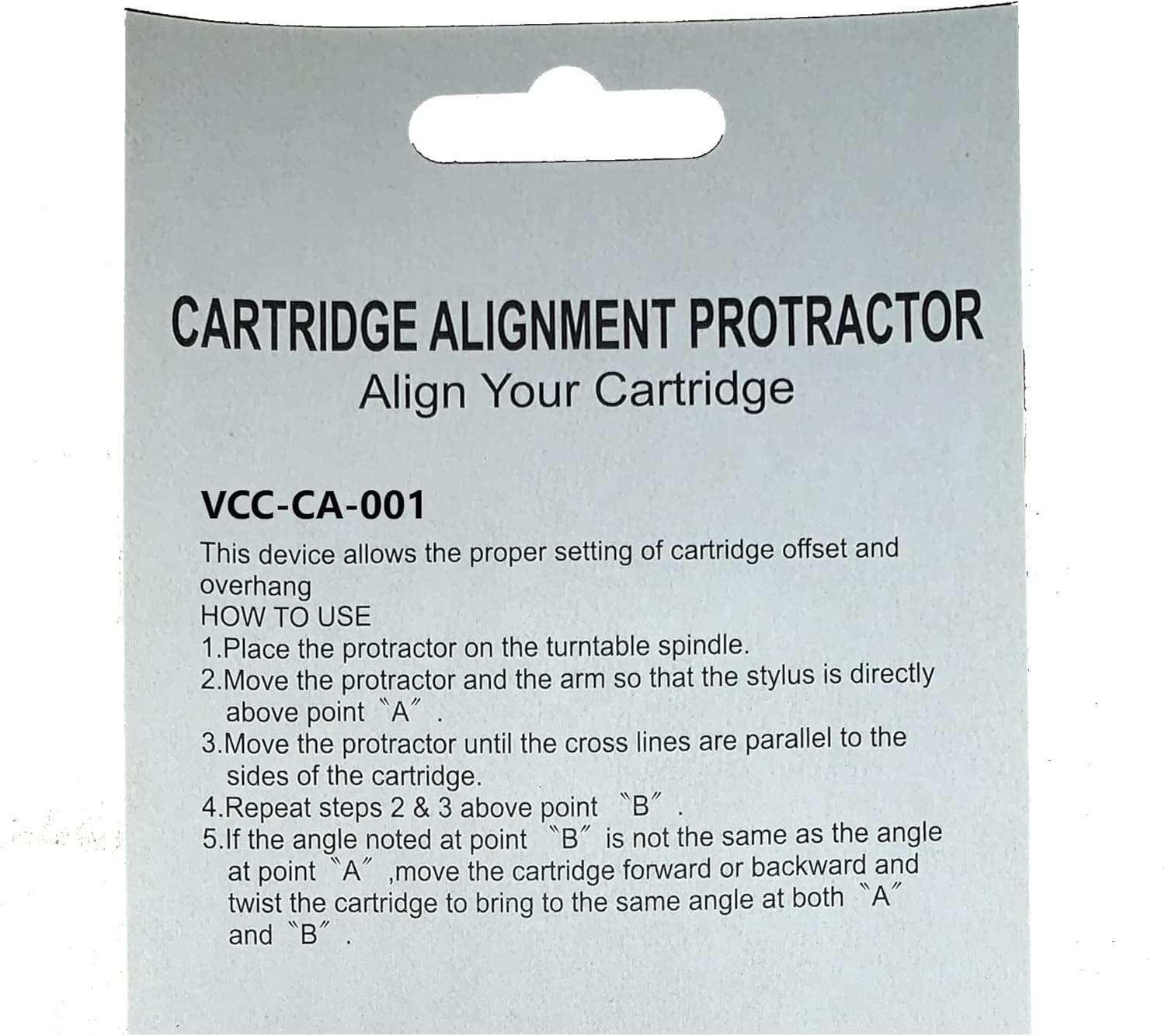
The protractor is a flat piece of about 2 millimeter ABS plastic with a mirrored surface, placed over the turntable spindle so the cartridge can be positioned against printed grid lines while checking both a top view of the stylus and its reflection in the mirror below. It uses Baerwald alignment geometry, a widely referenced standard that places two null points, roughly 66 millimeters and 121 millimeters from the spindle, to minimize average tracking distortion across the record's playing surface rather than eliminating it at any single point. Because it is a physical, reusable tool rather than a printed template, it holds its shape and markings over repeated use, and instructions for the alignment process are printed on the back of the tool itself.
Using it during a cartridge setup
In practice, alignment means loosening the cartridge screws slightly, placing the protractor over the spindle, and adjusting the cartridge's position and angle at each of the two marked null points until the stylus cantilever lines up with the printed grid and its own mirrored reflection at the same time. This is typically done alongside setting tracking force and anti-skating, so it fits naturally into the same setup session as mounting a new cartridge like the AT91 or AT95E. Because the tool has no moving or wearing parts, it needs no maintenance between uses beyond keeping the mirrored surface free of scratches, and it can be reused whenever a cartridge is remounted or replaced in the future.
Where this geometry fits among the alternatives
Baerwald geometry is one of several recognized alignment standards, alongside options like Loefgren B and Stevenson, and different tonearm manufacturers sometimes recommend a different geometry for their specific arm length and design. A protractor built around Baerwald null points, like this one, will get most turntables close to optimal, but buyers with a tonearm that specifies a different standard may find another protractor, or a printed template matched to their exact arm, a better fit. Compared with a printed paper template, this reusable mirrored tool holds up better over repeated use and offers a clearer view of stylus position thanks to the mirror, which is the main advantage buyers are paying for over a free downloadable version.
Verdict
For the price of a basic accessory, this protractor gives a manual turntable owner a repeatable way to check and correct cartridge alignment using an established, widely trusted geometry. It asks for a careful hand and a few minutes of patience rather than offering a one-click fix, and it will not match every tonearm's specific factory geometry. Anyone setting up or replacing a cartridge on a manual deck like the Fluance RT80 should treat a tool like this as a worthwhile companion purchase, while owners of automatic, pre-aligned decks can safely skip it.
Frequently asked questions
What alignment standard does this protractor use?
It uses Baerwald geometry, which places two null points at roughly 66 and 121 millimeters from the spindle to minimize average tracking distortion.
Is it reusable?
Yes, it is a durable plastic tool with a mirrored surface rather than a one-time paper template, so it can be reused whenever a cartridge is remounted.
Do I need any other tools to use it?
You will also want a way to set tracking force and anti-skating, since alignment is normally done as part of the same cartridge setup session.
Will it work with any turntable?
It fits any turntable where the cartridge sits over a standard spindle, but some tonearms are designed around a different geometry standard than Baerwald, so it may not be the exact factory recommendation for every arm.
Prices change often, so check the current price and availability on Amazon.
Check price on AmazonTurntable Nest may earn a commission from the link above.