Sumiko Blue Point No. 3 Low Output MC Moving Coil Phono Cartridge Review (2026)
Updated September 21, 2026 · Research-based review
Our verdict
The Sumiko Blue Point No. 3 Low suits a listener whose phono stage already offers dedicated MC gain and wants the more refined version of a long-running Sumiko design. It rewards careful system matching with detail and smoothness, but it will sound quiet and noisy on an MM-only phono stage.
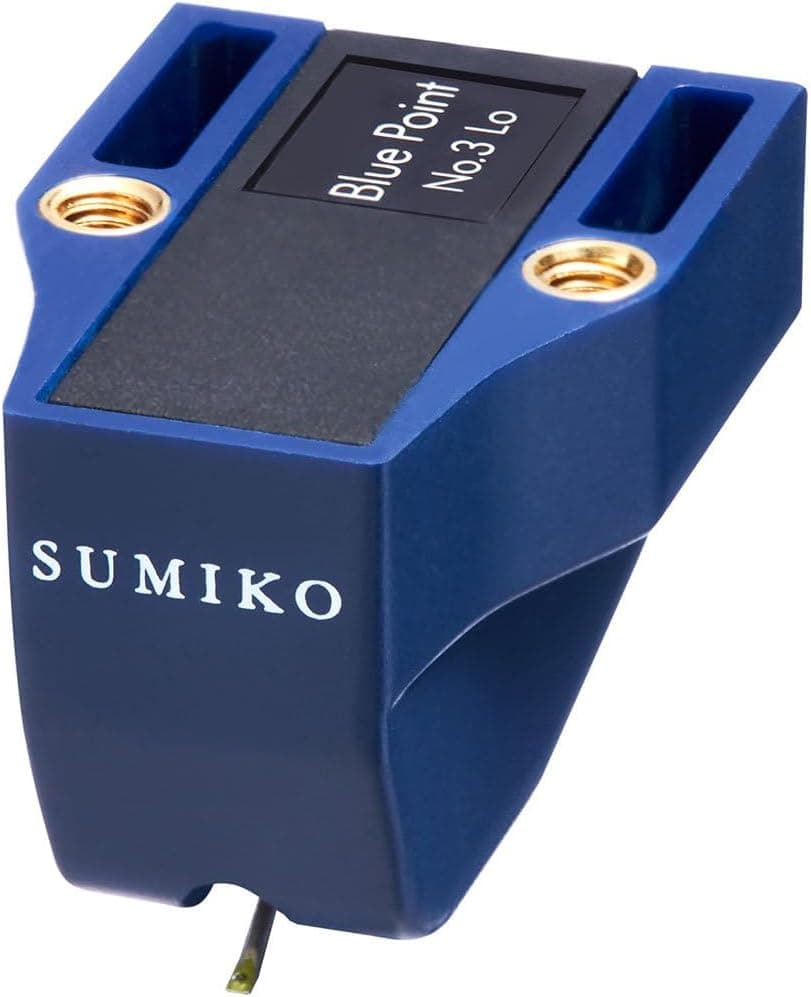
Sumiko Blue Point No. 3 low output MC cartridge, the purist version for systems with dedicated MC gain.
Price range: See on Amazon
What we liked
- + Low output version offers extra refinement over the high output model
- + Great match for phono stages that already offer MC settings
- + Sumiko Blue Point No. 3 name has a long history among analog fans
Trade-offs
- - Will sound quiet and noisy on an MM-only phono stage
- - Requires system planning before buying, unlike plug-in MM options
Output and impedance
This low-output version of the Blue Point No. 3 puts out 0.5mV at 1kHz with an internal impedance of 28 ohms, figures that sit it firmly among cartridges that need genuine moving coil gain to work well. Sumiko recommends a load impedance above 100 ohms, to be fine-tuned by ear, similar guidance to other cartridges in its lineup. Buyers coming from a moving magnet-only phono stage or an all-in-one receiver without MC support should treat this cartridge as requiring a system upgrade alongside it, not just a straightforward cartridge swap, since the signal level is meaningfully lower than a typical MM cartridge produces.
Stylus, cantilever and tracking
Sumiko fits the Blue Point No. 3 Low with a 0.3 by 0.7 mil elliptical stylus on an aluminum cantilever about 0.5mm in diameter, and specifies a recommended tracking force of 2.0 grams within a 1.8 to 2.2 gram range, with a 20 degree vertical tracking angle. Cartridge mass is 6.1 grams, lighter than many moving coil designs, which should suit tonearms tuned for lower to medium mass cartridges without needing extra counterweight adjustment. Frequency response is rated at 13Hz to 30kHz and channel separation is 30dB at 1kHz, both solid numbers for a cartridge positioned as an accessible entry into serious moving coil sound.
Low output versus high output
Sumiko sells the Blue Point No. 3 in both low and high output versions, and the low-output model reviewed here trades convenience for refinement: fewer turns of copper in the coil reduce moving mass and internal impedance, which the company says brings improved resolution, superior three-dimensionality and richer, more potent bass compared to the higher-output variant. That makes the low-output version the purist's pick for a system already built around MC gain, while the high-output version exists specifically for listeners whose phono stage cannot handle a low-output signal. Choosing between them really comes down to what a buyer's existing phono stage already supports.
Heritage and build
The Blue Point No. 3 name carries a long history in Sumiko's catalog among analog enthusiasts, and this cartridge continues that line with hand assembly in Japan and coils made of high-purity copper. As with essentially every moving coil cartridge, the stylus is not user-replaceable, so a worn or damaged stylus is handled through a dealer retip exchange program rather than a simple stylus swap at home. That servicing model is standard for the category and something buyers should factor into the long-term cost of owning any moving coil cartridge, not a unique drawback of this particular model or brand.
Who should buy this cartridge
This is the right choice for a listener whose phono stage already has a moving coil setting or a compatible step-up transformer and who wants a smooth, sweet-sounding cartridge with strong detail retrieval and transient response rather than an aggressive, forward presentation. Its lighter 6.1 gram mass also makes it a reasonable match for tonearms that are not built for heavier cartridges. Anyone without MC gain on hand should either budget for that upgrade or consider the high-output version of the same cartridge instead, since plugging this low-output model into an MM-only input will produce disappointing, underpowered results rather than the refinement it is designed to deliver.
Frequently asked questions
Will this cartridge work on a moving magnet-only phono stage?
Not well. Its 0.5mV low output needs a phono stage with MC gain or a step-up transformer; on an MM-only input it will sound quiet and noisy.
What is the difference between the low and high output versions?
The low-output version uses fewer coil turns for reduced mass and impedance, which Sumiko says improves resolution, dimensionality and bass, but it requires a phono stage with real MC gain that the high-output version does not need.
What tracking force should I use?
Sumiko recommends 2.0 grams, within an acceptable 1.8 to 2.2 gram range.
Can I replace the stylus myself?
No, the stylus is not user-replaceable. Sumiko handles servicing through a dealer retip exchange program rather than a simple at-home swap.
Prices change often, so check the current price and availability on Amazon.
Check price on AmazonTurntable Nest may earn a commission from the link above.