SpinTunes Turntable Phono Cartridge Stylus Alignment Protractor Tool Review (2026)
Updated September 14, 2026 · Research-based review
Our verdict
The SpinTunes protractor is a budget acrylic tool for checking cartridge overhang and offset angle at home, using UV-printed high-contrast markings that are easy to read without a mirror. It gets a newly mounted cartridge into the right ballpark, but buyers wanting an azimuth check or a named standard should look elsewhere.
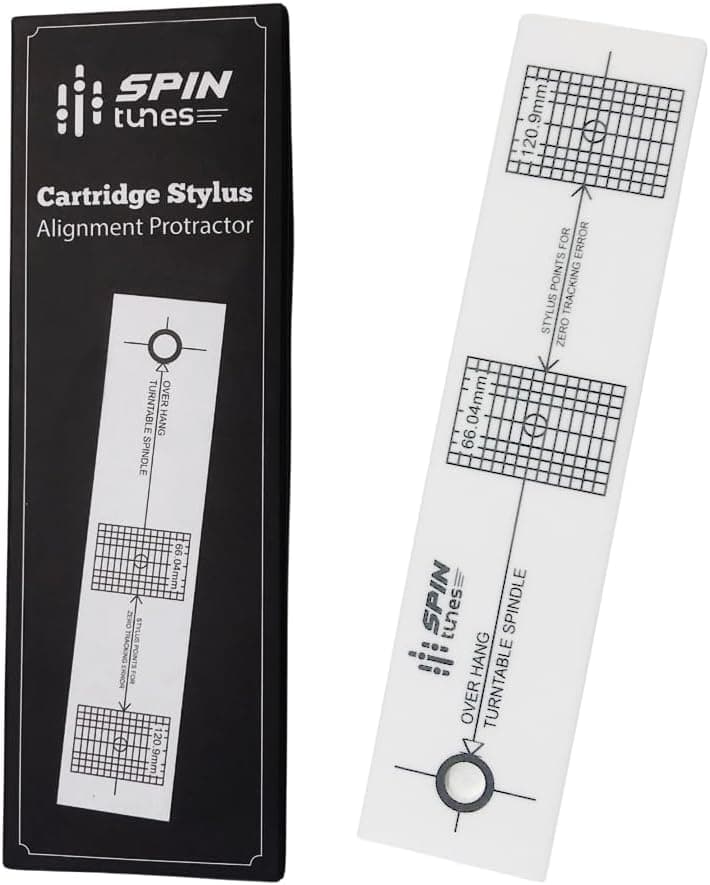
SpinTunes turntable phono cartridge stylus alignment protractor, a budget tool for dialing in a newly mounted cartridge.
Price range: See on Amazon
What we liked
- + Protractor design guides overhang and offset angle setup at home
- + SpinTunes brand focuses on vinyl accessories and care
- + Simple printed tool is easy to store with your record gear
Trade-offs
- - Printed card style can be less precise than mirrored acrylic tools
- - No stated geometry, so matching your tonearm needs research
Who this alignment tool is for
This is an entry-level cartridge alignment protractor made from transparent acrylic, aimed at someone who has just installed a new cartridge or headshell and wants a straightforward way to set overhang and offset angle without buying a premium mirrored tool. It suits hobbyists doing their first cartridge swap who want printed reference lines that are easy to read rather than the more involved sighting technique a mirrored protractor requires. Because it is a manual, printed tool rather than a mechanical jig, it also suits anyone comfortable taking a slow, careful approach with a small screwdriver. Owners chasing the most precise possible setup, or who specifically want to check azimuth as well as lateral alignment, may find this tool's feature set more basic than what they are after.
How the printed design works
The protractor is made of acrylic with UV precision printing, which SpinTunes uses to create high-contrast markings that stay legible without needing a mirror or extra lighting the way some mirrored tools do. In use, the stencil sits over the turntable's spindle and the cartridge's stylus is checked against printed reference points and a tangent line at two positions across the record surface, the standard two-point method for setting overhang and offset angle on a pivoting tonearm. Small adjustments to the cartridge's position in the headshell bring the stylus into line with the printed marks. The listing does not state which specific alignment geometry, such as Baerwald or Stevenson, the printed points follow, so it should be treated as a general-purpose alignment aid rather than a tool built around one named standard.
Setting up a cartridge with it
Using the tool starts with removing the platter mat or record and laying the protractor flat over the spindle, then lowering the tonearm so the stylus rests on the first marked point while you check whether the cartridge body lines up with the printed tangent guide, loosening the headshell screws with a small screwdriver as needed to nudge it into place. The process is repeated at the second reference point until both line up reasonably well, which is the normal give-and-take of protractor-based alignment on any tonearm. Good overhead lighting helps read the high-contrast print clearly, and working slowly, rechecking both points after each adjustment, tends to produce a steadier result than rushing through it in one pass.
Trade-offs and rival tools
Because the tool is printed rather than mirrored, it does not offer the azimuth-checking capability that a reflective surface provides, so cartridges that need vertical alignment checked as well as lateral overhang will need a separate tool or method for that step. The unnamed alignment geometry is also a gap for anyone with a strong preference for a specific standard. In the same guide, the VCC Cartridge Mirrored Alignment Protractor built around the Baerwald standard and the Turntable Lab mirrored protractor both score higher, generally reflecting the added precision and azimuth-checking ability that a mirrored surface brings over a printed acrylic card.
Verdict
For a first cartridge alignment on a budget, or as a simple backup tool to keep alongside your record gear, the SpinTunes protractor does a reasonable job and earns our score of 7.1 out of 10. Buyers who want to check azimuth in addition to overhang, or who care about matching a specific named alignment standard, should step up to a mirrored protractor such as the VCC or Turntable Lab options in the same guide. Anyone comfortable with a basic printed reference and a careful, patient approach will get a usable alignment from this tool.
Frequently asked questions
Does the SpinTunes protractor check azimuth?
No, because it is a printed acrylic tool rather than mirrored, it is built for lateral overhang and offset angle alignment, not for sighting vertical azimuth.
What alignment standard does it use?
The listing does not name a specific geometry such as Baerwald or Stevenson, so treat it as a general-purpose two-point alignment aid rather than one built around a named standard.
Do I need extra tools to use it?
You will need a small screwdriver to loosen and retighten the cartridge mounting screws in the headshell while making adjustments; it is not included.
Is this suitable for a first-time cartridge alignment?
Yes, its high-contrast printed markings are designed to be easy to read, which makes it approachable for someone aligning a cartridge for the first time.
Prices change often, so check the current price and availability on Amazon.
Check price on AmazonTurntable Nest may earn a commission from the link above.